

Before we get onto the subject of our UK Government petition — which I am so thrilled has surpassed 10,000 signatures today according to my very faithful and indomitable assistant, Kath — this is the first public sort of address I am doing since I closed my social media profiles and many other platforms and online accounts to begin a digital departure. Which I suppose, if you’re reading this, doesn’t really feel like a digital departure, but for me it does. Since I’m not in the space where this is being published, and I am not online to read the comments.
However, I am told by the amazing people working with me on Super Connected that it was important to say something. So here I am, writing in my little study, looking out the window at the naked pear tree in the back garden, whom I must thank for the very delicious pears this year.
But before I do, I must thank everybody, each and every one of you who have signed the petition and got it to an amount that means it qualifies for a government response.
The Spark of the Super Connected Petition
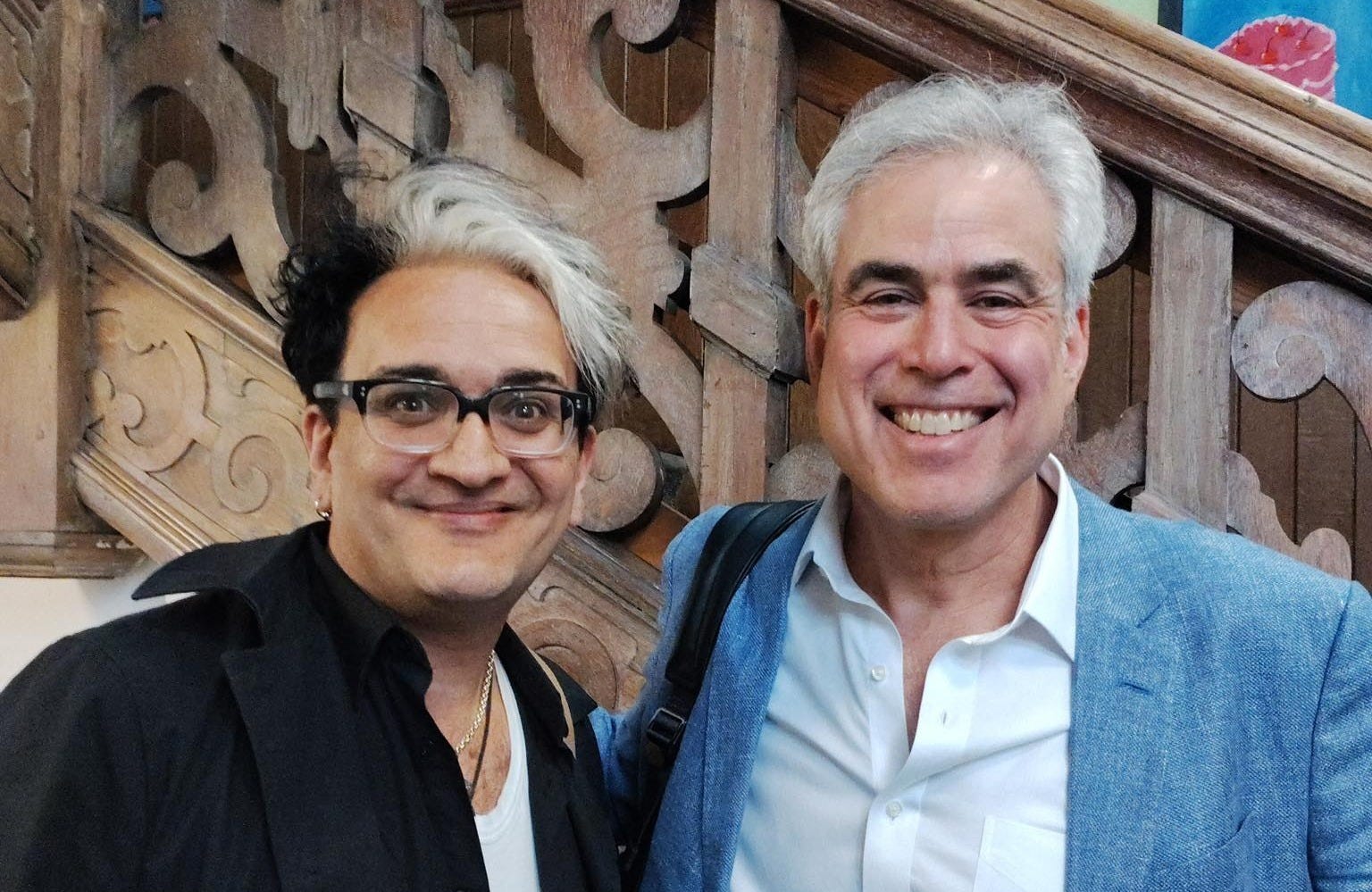
This petition really was inspired by meeting the author Jonathan Haidt earlier this year, when he gave an address along Sophie Winkleman and Hugh Grant about EdTech and the pervasive way in which technology has entered into our school systems — in a way that is normalising the out-of-school use of technology, specifically with social media apps that feel very much the norm for children. But as our disruptive little theatre company demonstrate in the true story of Super Connected this norm has been causing serious mental and emotional damage to children and teenagers since the advent of the first front-facing-camera phones in 2010.
I was genuinely upset to hear Hugh talking about the lack of explanation from his own children’s school. When asking the teachers why they needed to have these devices for homework as well as at school, there didn’t seem to be any answers at all.
For many of us, like Hugh or myself who have often been at the end of lengthy campaigns battling corporations, there would certainly be some sort of financial incentive between the concerned parties as to why children are having to use devices to read and write on instead of pen and paper.
You only need to go to Maryanne Wolf, Director of the Center for Dyslexia, Diverse Learners, and Social Justice at UCLA, to understand that for children, the very qualities of inference and imagination depend on us reading from a page that has no other applications minimised at the bottom of the screen. When they are minimised in the window of the screen, they are actually still present in our brain and drawing on huge quantities of attention and energy without us realising- and I’m talking about us as adults too! Our ability to focus is split form the start and devoid of intentionality. Imagine the comparative energy it draws from a child’s brain.
And thats a norm?
That is pretty much the moment I decided to start this petition.
The Petition’s Journey
Originally, the title of the petition was something much more akin to:
“Empower parents to have a legal right to refuse for their children to have to learn on Chromebooks, iPads, or any other digital device”
But I knew that that would not get the support of the petition committee. So I changed it to “Provide a legal right to access essential services without a digital device” — and actually, that title was rejected anyway. It was suggested to me by the petition committee that I could not use the word essential, and they suggested certain instead.
Since my actual reason behind the petition was still safely stowed away in the title, I just accepted that and published it and created a page on our Digital Wellbeing page.
As we know from groups like Smartphone-Free Childhood, Delay Smartphones, Health Professionals for Safer Screens and Close Screens, Open Minds, it is not an ambition easily sated to bring the current government — or indeed perhaps any government — to recognise the serious neurodevelopmental impact that digital technology has on the developing brain of a child.
And yet, we must also ensure future generations are proficient in digital literacy.
I am absolutely in support of a future where children become adults who are able to write and read code and keep innovating through technology to make the world a better place. But if you think getting a smartphone into the hands of a child as soon as possible is the right way to do that, many an expert would show you, as they have shown me, the evidence that proves that to be incorrect.
Thanks to author Todd Oppenheimer’s book The Flickering Mind, we all knew this in 2004, when his research shows that:
The only thing that can improve education in the classroom is… a teacher.
But the key thing here is that we are now talking about two languages.
Bilingual children who speak English and French don’t use French to understand Shakespearean words and probably wouldn’t use English to read The Three Musketeers. Reading each book that was created and imagined in a particular language and landscape is best experienced using that same language. At least to start with. I was a bilingual child and I read Don Quixote in Spanish. It just makes more sense.
Let your imagination grow by reading Hemingway and Hesse from a page, where your mind can wander, infer and imagine — and use your Chromebooks and iPads to encode a website about the work of those authors so other people can discover them…and go back to the page.
The Bilterate Brain
That’s the biliterate brain in action: moving effortlessly and safely between deep, thoughtful reading and digital fluency.
Using each language for the appropriate activity.
But we can’t get there if children are being taught all human experiences and activities through only one of those languages: the digital device.
Maryanne Wolf’s concept of the “biliterate brain” refers to the ability to effectively switch between two different ways of reading: the fast, skim-based reading typical of digital media and the deep, critical, and empathetic reading that comes from reading physical books - the ones that enable the reader to collaborate with the writer.
Developing this biliterate brain is crucial for critical thinking and adaptability in the modern world. Who wouldn’t want that for their child?
It’s not going to happen if your child is reading poetry with a powerful digital stimulant waiting in another window on the same screen they are reading from.
I went with the adapted petition title knowing it still contained my true intention, which was to make sure that any parent in the UK could go into their school and say:
“I’m sorry, my child doesn’t use devices yet,”
…in the same way that my mother walked into my school back in the 1980s and said, “I’m sorry, my son doesn’t eat meat.”
When I was a child, my vegetarianism raised eyebrows. I was teased and peers sometimes scoffed. But I survived.
So will children who stick out for not having a smartphone.
Let’s say ‘stand out’ because that’s what it is if you’re choosing a healthier option to the masses. And honestly, we are talking about the same thing: diet and consuming.
Everything that becomes popular starts out unpopular.
- Vivienne Westwood
But it’s parents and grandparents that need to facilitate that change. It’s not that digital life should be a choice. It already is. But it’s crucial that our children know this - which I inferred in the last line of the petition description if you click on more details.
Innovation actually benefits from brains that have grown and matured without ‘smart’ technology. We can certainly look back to the past and see that this is true for anyone from Leonardo da Vinci, Florence Nightingale, Albert Einstein, or Marie Curie, who managed their achievements without using a smartphone as a child or as an adult.
Allies and Challenges
As an independent artist, living only through the kind subsidy of institutions like the Arts Council and charities like Help Musicians, I knew I would not be able to make a dent toward the hundred thousand signatures needed for a parliamentary debate. Which is why I went to respected public figures and friends, such as Stephen Fry, Imelda Staunton, Olivia Colman, and many more, along with the doctors and teachers whose work in this space deserves to be heard so much more than it is.
But it would seem that as soon as I engaged these very popular names, every single channel that we attempted to push the petition through was not supportive — not in the mainstream media and definitely not on social media. I seemed to have hit a nerve.
Despite this, thanks to the hard work of predominantly grassroots groups, and especially in these final weeks when I had to make my digital departure, to my assistant Kath, we’ve reached 10,000 signatures.
A Grassroots Milestone
In some ways, 10,000 signatures achieved by a grassroots approach is infinitely more significant than 100,000 signatures through a campaign that’s received mainstream national media attention and become part of the very digital diet we are calling out.
This result is real. We can believe it. These are 10,000 real people in this country who share my vision of the kind of future we want for children, and that I already had as a child — a blessing to spend time and space at a pace where I could develop as a human being, able to release the unique character and spirit I came to Earth with, without being interrupted by downloads, tutored in record time through YouTube channels, nudged by countless social media apps or judged on the metrics of my outcomes. To teach means to ‘draw out’. We don’t need to fill children up with what they lack. We need to draw out what comes pre-packed within their very being.
The Bridge We Must Build
Whilst we might not be able to push the petition to 100,000 signatures in the next nine days before the deadline, this is a strong brick in a bridge that we are building.
It is a bridge for human beings born into the digital age to be able to walk across and experience the phenomenological world before they embrace the (very important) digital world as adults. Instead of just swimming through the stream of toxic, experience-blocking and currently dangerous landscape of the digital world.
Please, let’s all keep building that bridge.
Tim Arnold, Tuesday, 11th November
Resources for parents, teachers and allies:
Stay In Touch and Find Out What’s Next
Super Connected Digital Family Hub
Health Professionals for Safer Screens
Smartphone Free Childhood
Delay Smartphones
Close Screens, Open Minds
Ed Tech Law